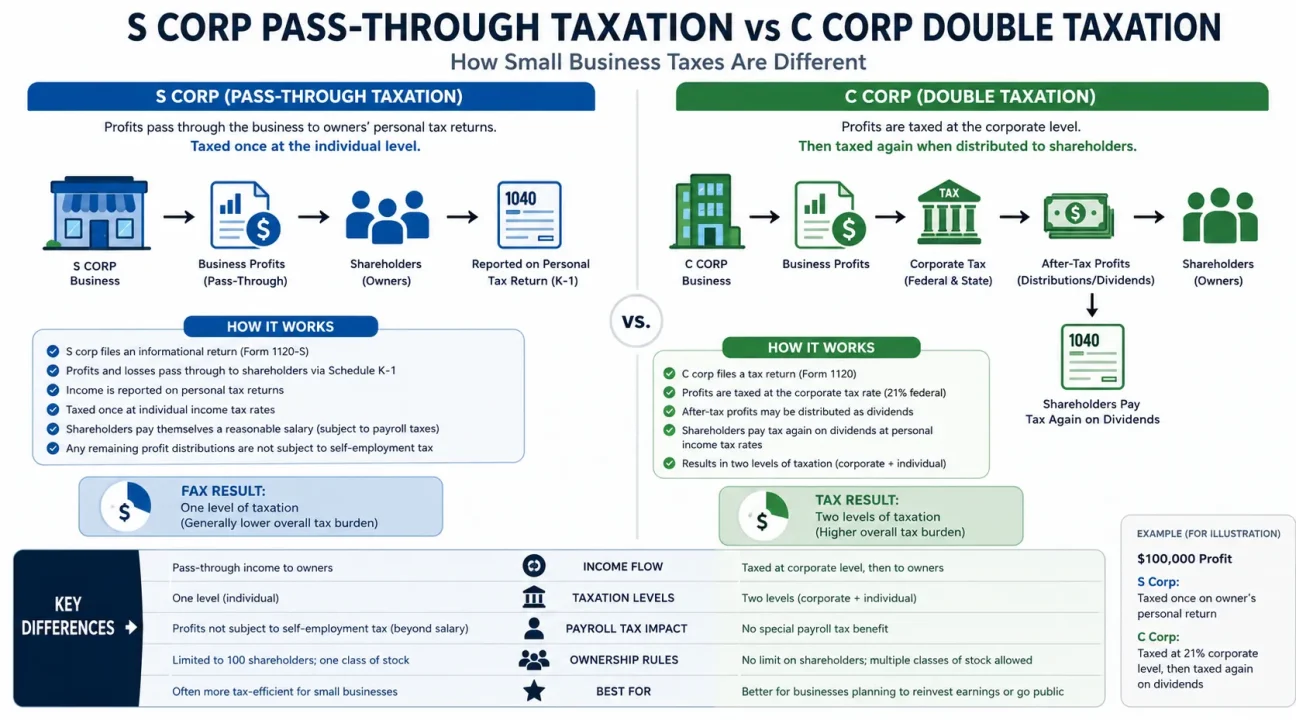
By Christie Imfeld CPA
If you’re running a small business and structured as an LLC, sole proprietorship, or even a C corp, you’ve probably asked yourself whether an S corp election would save you money. The short answer for most small business owners is yes. The tax advantages of S corp over C corp status are real, measurable, and in many cases worth thousands of dollars a year. But the decision isn’t automatic, and it depends on your income, your payroll setup, and how you plan to grow.
This article breaks down exactly where an S corp beats a C corp on taxes, where a C corp still makes sense, and what you need to weigh before making the switch.
The Core Difference: How Each Entity Is Taxed
Before comparing S corp vs C corp tax advantages, it helps to understand how the IRS treats each one.
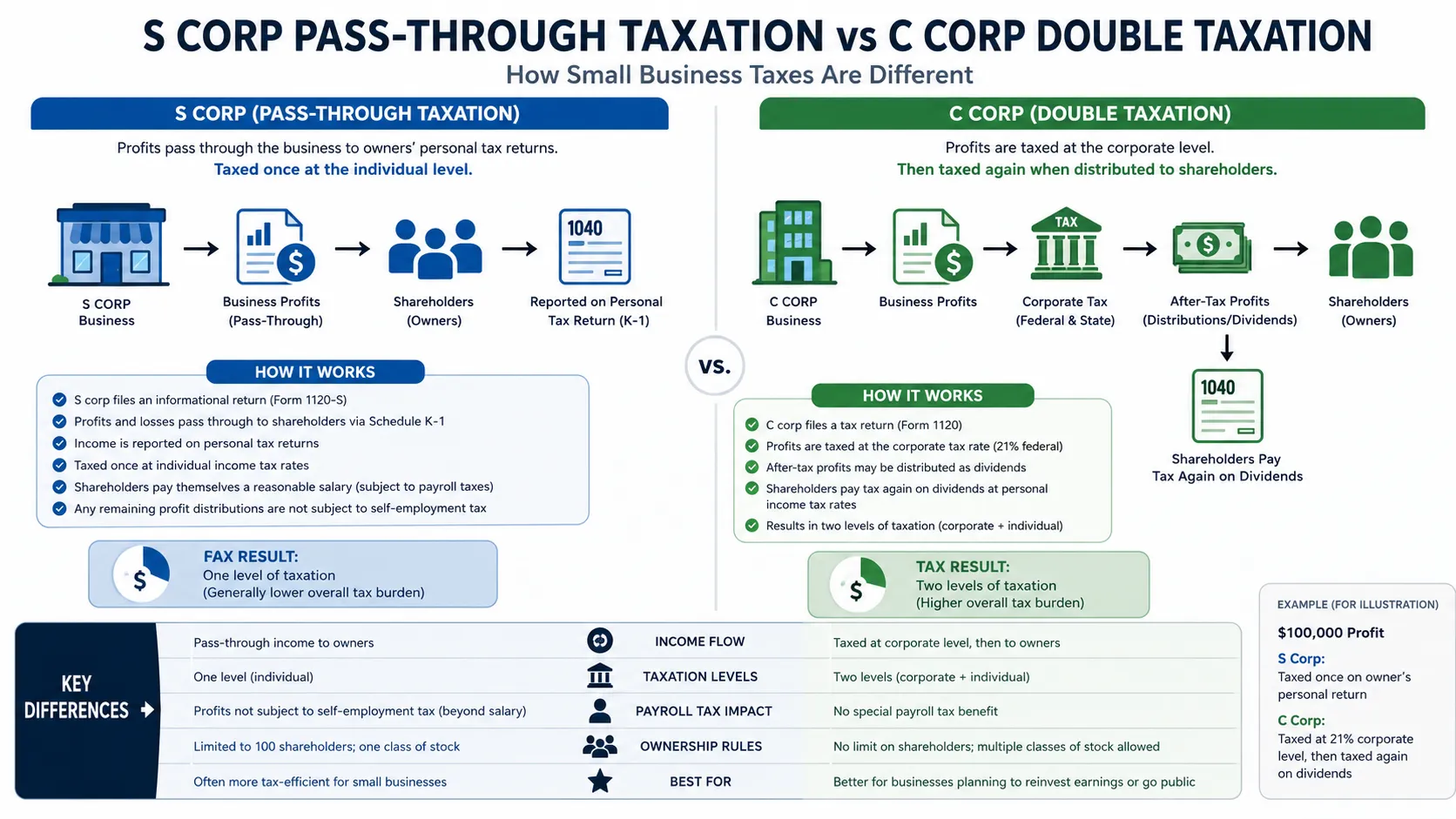
A C corporation is taxed as its own separate entity. It pays a flat 21% federal corporate income tax on its profits. Then, when those profits are distributed to shareholders as dividends, the shareholders pay tax again on that same money at the individual level. This is what’s known as double taxation, and it’s the single biggest reason small business owners avoid the C corp structure unless there’s a specific reason to use it.
An S corporation, on the other hand, is a pass-through entity. The business itself doesn’t pay federal income tax. Instead, profits and losses pass through to the owners’ personal tax returns, and they pay tax at their individual rate. There’s no second layer of tax at the corporate level. This single structural difference is where most of the S corp tax advantages come from.
1. No Double Taxation
This is the headline advantage, and it’s worth spelling out with real numbers.
Say your business earns $150,000 in profit. As a C corp, the business pays 21% corporate tax, which is $31,500, leaving $118,500. If that remaining amount is distributed to you as a dividend, you pay personal income tax on it again, often at a rate between 15% and 20% for qualified dividends, sometimes higher depending on your bracket. That second layer of tax can easily add another $17,000 to $24,000 to your total tax bill.
As an S corp, that same $150,000 in profit passes straight through to your personal return. You pay tax once, at your individual rate, with no corporate-level tax sitting on top of it. For a profitable small business that plans to pay its owners through distributions rather than reinvesting everything back into the company, this alone can be the deciding factor between the two structures.
2. Self-Employment Tax Savings Through Reasonable Compensation
This is where S corp status tends to save small business owners the most money in practice, especially compared to being taxed as a sole proprietor or a single-member LLC.
If you’re self-employed, every dollar of net business income is subject to self-employment tax, which covers Social Security and Medicare and currently sits at 15.3%. There’s no way around it because the IRS treats all of your business profit as earned income.
With an S corp, you’re required to pay yourself a reasonable salary for the work you do, and that salary is subject to payroll taxes, which function the same way as self-employment tax. But any additional profit beyond that reasonable salary can be taken as a distribution, and distributions are not subject to self-employment tax or payroll tax.
Here’s an example. Say your business nets $120,000 and a reasonable salary for your role is $60,000. As a sole proprietor, you’d owe self-employment tax on the full $120,000. As an S corp, you’d pay payroll tax on your $60,000 salary, and the remaining $60,000 distribution avoids that 15.3% tax entirely. That’s a savings of roughly $9,000, depending on wage base limits and your specific numbers.
This is one of the clearest tax advantages of an S corp over both a C corp and a sole proprietorship, and it’s the main reason many single-member LLCs elect S corp status once their profits reach a certain threshold, often somewhere between $60,000 and $80,000 in net income.
3. The Qualified Business Income Deduction
Since the Tax Cuts and Jobs Act, and now made permanent under the One Big Beautiful Bill Act signed in July 2025, pass-through business owners have access to the Qualified Business Income deduction under Section 199A. This allows eligible S corp owners to deduct up to 20% of their qualified business income from their taxable income.
For 2026, the full deduction is available for single filers with taxable income under roughly $201,750 and for joint filers under roughly $403,500, with wider phase-in ranges than in prior years. Starting in 2026, there’s also a new minimum deduction of $400 for owners with at least $1,000 in qualified business income who materially participate in the business, which helps smaller and newer businesses see some benefit even in leaner years.
C corp shareholders don’t get this deduction because C corp income isn’t passed through to the individual return in the same way. It’s taxed entirely at the corporate level instead. For an S corp owner in the 32% tax bracket with $100,000 of qualified business income, a 20% deduction shields $20,000 from tax, which works out to roughly $6,400 in federal tax savings. That’s on top of the self-employment tax savings mentioned above.
4. Simpler Pass-Through Loss Treatment
If your business has a loss, an S corp allows that loss to pass through to your personal return, where it can offset other income you have, subject to basis and at-risk limitations. This can meaningfully lower your overall tax bill in a slow year.
A C corp’s losses stay locked inside the corporation. They can be carried forward to offset future corporate profits, but they don’t do anything for your personal tax return in the year they occur. If you’re a small business owner who might personally benefit from offsetting a bad year with other income, this is another point in favor of the S corp structure.
5. No Corporate-Level Tax on Built-In Gains for Most Small Businesses
C corps that convert to S corp status, or S corps that were previously C corps, sometimes face something called the built-in gains tax if they sell appreciated assets within five years of the conversion. This is a corporate-level tax that essentially claws back some of the benefit of avoiding double taxation.
For most small businesses that have been S corps since formation and don’t hold significant appreciated assets like real estate, this isn’t a major concern. But it’s worth knowing about if you’re planning to convert from a C corp, since it affects the timing of any asset sales after the switch.
Where a C Corp Still Makes Sense
It wouldn’t be honest to present this as a one-sided decision. C corps have real advantages in specific situations, and they’re worth mentioning even in an article focused on S corp benefits.
C corps can retain earnings inside the business at the flat 21% corporate rate without that income being taxed again until it’s distributed. For a business that’s reinvesting heavily and not paying out profits, this can actually result in a lower effective tax rate than passing everything through to a high personal income bracket.
C corps also don’t face restrictions on the number or type of shareholders, while S corps are limited to 100 shareholders who must be U.S. citizens or residents, and can only issue one class of stock. If you’re planning to raise venture capital, bring on foreign investors, or eventually go public, a C corp structure is usually required.
C corps can also offer a wider range of tax-free fringe benefits to owner-employees who hold more than 2% of the company, something S corp owners face more restrictions on.
Which One Fits Your Business
For most small business owners who are actively working in the business, taking home profits as personal income, and not planning to raise outside institutional investment, the tax advantages of an S corp over a C corp tend to outweigh the benefits of staying a C corp. The combination of avoiding double taxation, reducing self-employment tax through reasonable compensation, and qualifying for the QBI deduction adds up to meaningful savings for most profitable small businesses.
That said, the numbers depend entirely on your specific income, your industry, your reasonable salary calculation, and your long-term plans for the business. What works for a landscaping company with $150,000 in profit might not work the same way for a business planning to bring on outside investors in the next two years.
The right structure is the one that matches where your business actually is and where it’s headed, not a generic rule of thumb. Getting the reasonable compensation number right also matters more than most owners realize, since the IRS does scrutinize S corp salaries that look artificially low.
If you’re weighing an S corp election or wondering whether your current structure is still the right fit, explore my corporate structure and entity selection service for guidance built around your actual numbers, or call me directly at (513) 324-8347 to talk through what makes sense for your business.