
By Christie Imfeld, CPA
If your weekly team meeting feels like a calendar obligation nobody looks forward to, it’s not a meeting problem. It’s a structure problem. The Level 10 meeting, a core component of the Entrepreneurial Operating System (EOS), was designed specifically to fix that. But like any tool, it only works when used correctly. A lot of leadership teams are running what they call a Level 10 meeting while unknowingly stripping out the parts that make it effective. This post breaks down exactly how to run one that earns that score.
What Is a Level 10 Meeting?
The Level 10 meeting is a weekly 90-minute meeting format introduced by Gino Wickman in his book Traction. It’s built for leadership teams running on EOS, but the format is practical enough that businesses at any stage can adapt it. The name comes from the goal of rating each meeting out of 10. If the meeting consistently scores an 8, 9, or 10, it means the time was well spent. If it’s scoring 5s and 6s, something in the structure is off.
The format is designed to eliminate the kind of meetings where you spend 45 minutes on updates nobody needed to hear out loud, then run out of time for the decisions that actually matter.
The Level 10 Meeting Agenda
The agenda is fixed. That’s intentional. Every meeting follows the same sequence, which means participants know what to expect, come prepared, and the meeting doesn’t drift.
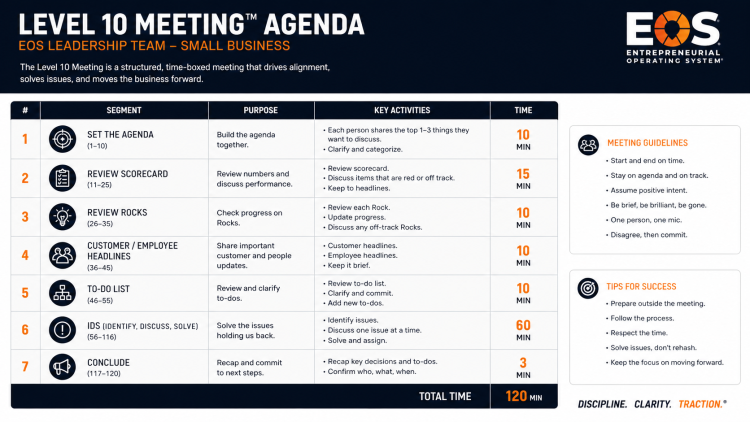
Here’s the standard Level 10 meeting agenda and approximate time blocks:
Segue (5 minutes) Scorecard review (5 minutes) Rock review (5 minutes) Customer and employee headlines (5 minutes) To-do list review (5 minutes) IDS: Identify, Discuss, Solve (60 minutes) Conclude: recap, rating, and close (5 minutes)
The IDS portion is the engine. Everything before it is designed to surface issues quickly so the bulk of the meeting can be spent solving them.
Why Most Level 10 Meetings Go Sideways
Teams that are new to EOS often make the same mistakes. Knowing them in advance saves you weeks of frustrating meetings.
The segue gets skipped or stretched
The segue is a one-minute personal or professional win from each team member. It takes five minutes total and serves a specific purpose: it shifts people from the noise of their day into a focused meeting mindset. Some teams cut it because it feels unnecessary. Others let it run to ten or fifteen minutes because it turns into casual conversation. Both versions kill meeting momentum before it starts.
Updates replace decisions
The scorecard, rocks, and headlines sections are not discussion time. They are check-in time. If a metric is on track, you note it and move on. If it’s off track, it becomes an issue and gets dropped into the IDS section. The mistake most teams make is using these five-minute blocks to have ten-minute conversations. By the time IDS starts, people are already burned out or over time.
The IDS section has no discipline
Identify, Discuss, Solve is where the meeting earns its score. The facilitator’s job is to keep this section tight. That means identifying the real issue before discussion starts, timeboxing conversations that are going in circles, and making sure every IDS item ends with a resolution or assigned next action. When teams skip the “identify” step and jump straight to discussing symptoms, they often solve the wrong problem.
Nobody owns the facilitation
A Level 10 meeting without a consistent facilitator turns into a free-for-all. Somebody on the team needs to hold the agenda, call time, and redirect off-topic conversations. This role usually falls to the Integrator in an EOS structure, but in smaller teams it can rotate or belong to whoever runs operations.
How to Actually Prepare for a Level 10 Meeting
The meeting itself is 90 minutes. The preparation should take no more than 15. Here’s what good preparation looks like:
Update the scorecard before the meeting. Every metric that appears on the scorecard should be filled in before anyone sits down. If you’re waiting on numbers during the meeting, you’ve already lost five minutes.
Review your rocks. Rocks are your 90-day priorities. Each team member should know whether their rock is on track or off track before walking in. This is a binary answer, not a discussion.
Drop issues into the issues list. The IDS section works best when the issues list has been populated in advance. Most EOS teams keep a running issues list between meetings. Team members should add anything that needs to be discussed before the meeting starts, not during it.
Come with your to-dos complete. The to-do list carries over from the previous week. If a to-do isn’t done, it needs to be noted. Coming to the meeting without knowing the status of your action items slows the review and creates accountability gaps.
Running the IDS Section Without Letting It Derail
The IDS portion of a Level 10 meeting is 60 minutes and typically covers three to five issues. That’s roughly 12 to 20 minutes per issue. Here’s a practical approach to running it well.
Start with the issues list and let the team vote on priority. This takes less than two minutes and ensures the most important issues get solved even if you run out of time.
When an issue comes up for discussion, spend one to two minutes identifying the real problem underneath the surface complaint. This is the most underused step. Teams skip straight to solutions when the actual issue hasn’t been correctly named yet.
Timebox the discussion. If a conversation reaches eight minutes with no resolution in sight, either the issue hasn’t been properly identified or it needs more information before it can be solved. Either way, the answer is to create a to-do, assign it, and move on.
End every issue with a clear resolution. This could be a decision, an action item with an owner and a due date, or a determination that it needs more information. “We talked about it” is not a resolution.
The Closing Segment People Underestimate
The last five minutes of a Level 10 meeting include three things: a recap of all to-dos and decisions made, any messages that need to be cascaded to the rest of the company, and the meeting rating.
The rating is where teams get honest. Everyone scores the meeting from 1 to 10 and shares their number. If the average is below 8, the facilitator asks what would have made it better. This isn’t a formality. Over time, the ratings become a useful signal. A team that consistently scores meetings below 7 has a structural issue worth diagnosing.
Low scores usually point to one of three things: the IDS section ran out of time because earlier segments went over, the issues discussed weren’t the ones that actually mattered, or the team isn’t solving issues to resolution.

Making the Level 10 Meeting Work Long-Term
Consistency is what separates teams that get value from this format and teams that quietly abandon it. A few things make the difference over time.
Run it the same day and time every week. The Level 10 meeting works because it becomes a rhythm. When it gets rescheduled frequently, the issues list backs up, to-dos go unreviewed, and the meeting loses its function. Protect the time slot.
Don’t skip weeks unless absolutely necessary. Some teams cancel their Level 10 meeting when things get busy, which is exactly when they need it most. The whole point of the format is to create a consistent space where problems get solved before they compound.
Review your issues list between meetings. The issues list shouldn’t sit dormant until the next meeting. If something is resolved outside the meeting, remove it. If something new and urgent comes up, consider whether it warrants an impromptu conversation or can wait. A living issues list keeps the IDS section from turning into a backlog dump.
Revisit your scorecard design periodically. If your scorecard consistently has metrics that nobody is looking at or that don’t connect to outcomes anyone cares about, it’s time to update it. A scorecard full of vanity metrics produces check-ins that feel pointless.
A Note on Teams Not Running Full EOS
The Level 10 meeting format is rooted in EOS, but you don’t need to be a certified EOS Implementer or have every EOS tool in place to make it work. Many small businesses and growing teams borrow just the meeting structure and run it effectively without the full operating system underneath it.
If you’re not running rocks, replace the rock review with a 90-day priority check. If you don’t have a formal scorecard, use a short list of the five or six numbers that tell you how the business is doing week to week. The format is flexible enough to adapt without losing what makes it valuable.
What it does require is discipline. The fixed agenda, the time blocks, and the commitment to solving issues to resolution are what make a Level 10 meeting different from a regular staff meeting. Remove those elements and you’re back to the kind of meeting that scores a 5.
The Bottom Line
A well-run Level 10 meeting gives your leadership team 90 minutes of focused, structured time to check the pulse of the business and solve the issues slowing it down. Teams that run it properly stop repeating the same conversations week after week, make decisions faster, and leave each meeting with clear action items everyone is accountable to. The meeting isn’t magic. The structure is. Follow it, protect it, and rate it honestly every single week.
If your business is ready to build the kind of operational structure that makes meetings like this possible, explore our business advisory services for financial strategy, planning support, and small business guidance, or call us at (513) 324-8347 to talk through where your business stands right now.